



Click on image to play video
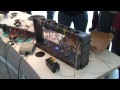
is an installation created by Yann Seznec and mushrooms expert Patrick Hickey. As the title suggests, Seznec's intention was to translate the movement of spores into sound. The phenomenon is largely confined to the undergrowth and - as such – is usually out of the reach of human perception. To address this idea the artist has created an elaborate installation in which mushrooms are isolated in glass containers. A magnifying glass focuses on the cap, which is irradiated by a laser beam. A camera, placed outside the container, films the scene and, using special software (written in Max / MSP and Jitter), several parameters are plotted, including the number of spores and the direction of their movement. These same parameters are transformed into input to drive (thanks to Arduino) musical instruments (a mini percussion section, some glasses etc.) created by Seznec using small solenoids. The viewer becomes aware, thanks to the sense of hearing, of the fall of the spores; and feels a childlike sense of wonder: we are like children who see a natural phenomenon for the first time.
Vito Campanelli
http://www.theamazingrolo.net/category/spores/

Click on image to play video
Político desrespeitando a lei (antes ou depois de ser eleito) é inadmissível!!
Somos um movimento apartidário, não apoiamos nem somos contra nenhum partido ou candidato. Mas não vamos permitir que a impunidade já comece antes mesmo do mandato, seja lá de quem for.
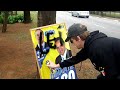
A Lei Eleitoral No. 12.034 permite a colocação de propagandas eleitorais em locais e horários específicos. Mas não é isso que alguns candidatos estão fazendo.
E SE A FISCALIZAÇÃO NÃO FAZ, NÓS FAZEMOS!!
Não somos a favor da destruição pela destruição. Vandativismo = vandalismo + ativismo (tá , óbvio, sabemos, mas nunca é demais deixar claro). E todas nossas ações foram praticadas de modo que não destruísse ou danificasse nada além das propagandas irregulares. (tomamos cuidado para que nenhuma árvore pegasse fogo, calçada fosse pichada, etc.)
Convidamos você para agira também: acesse nosso site www.vandativismo.wordpress.com e mande pra gente sua forma de impedir propagandas eleitorais ilícitas! Nós publicaremos a foto em nosso blog e colocaremos o nome do candidato em nossa lista.
Se você pretende fiscalizar/punir os políticos infratores também, por favor tome o mesmo cuidado. Não estamos aqui para destruir a cidade, e sim protegê-la.
Um abraço,
Grupo Vandativista
twitter.com/vandativismo
www.vandativismo.wordpress.com

Beethoven Piano Sonata, nr.1 - nr.14 (Senza Misura) from Samson Young on Vimeo.
Stripping the work of Ludwig van Beethoven of its musical components and performing only its tempo: this is the conceptual operation at the root of "Beethoven's Piano Sonata, no. 1 - no. 14" by Samson Young, a classically trained musician who is strongly oriented to electronica and installation art. In this case, the installation is made from 47 electronic devices, arranged symmetrically in a grid, each of which flashes and performs a ticking noise. Both effects are controlled by the tempo of one of the movements that make up Beethoven's first 14 sonatas. The small devices, working like metronomes (an instrument that Beethoven used for his work; a pioneering act at the time), are programmed specifically to perform the tempo of a single piece. The combination of flashing lights and ticks marks the rhythm of the Allegretti, Adagio and Rondò, in spite of the eternal domination of the (totally absent) melodies. Despite this overwhelming mutilation, the result is a hypnotic visual and aural representation, and it is difficult not to catch oneself looking for (almost impossible) synchronicities between sound or light, as a search for a melodic theme.
http://samsonyoung.blogspot.com/2010/05/finally-got-around-to-posting-video.html


Two fabric loops, driven by a motor divide space. At certain points there are light sensors installed to receive signals from the opacity of the textile, which get translated into audio signals.The musicality of the instrument can be experienced by sliding or positioning the sensor across the fabric tracks. It works as Mediaperformance as well as an interactive sound art installation.
http://www.kathrinstumreich.com/stofftonband/


