

Click on image to play video
When R. Murray Shafer conducted the International Sound Preference Survey a few decades ago, traffic noise was categorized as one of the least appreciated sounds in the world, together with dentist drills and chalk squeaking on blackboard. Sound artist Florian Tuercke has been spending the last few years attempting to transform the ever-hated noise of traffic into harmonious music, taking up a challenge that could be compared to the alchemist’s goal of turning lead into gold
http://www.youtube.com/user/urbanaudioorg
Click on image to play video
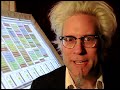
The mashup master Mark Gunderson, aka The Evolution Control Committee, has been in the music plagiarism field for the last couple of decades. One of his latest tactical products (after so many others) is called VidiMasher 3000. It's a 122-centimeter rear-projected faux touchscreen, which shows the overloaded Ableton Live software setup of loops Gunderson uses during his live, plagiaristic shows.
The VidiMasher 3000. Based off of Johnny Chung Lee's whiteboard, we assembled a four-foot rear-projected faux touchscreen. It's perfect for our Wheel Of Mashup shows, which depend on an overloaded setup of Ableton Live. Because it's overloaded, it's very difficult to mouse quickly and accurately enough to mash things up on the fly. The touchscreen solves that.
http://evolution-control.com/index.php/experiments/videos/151-video-mashup-screen-demo/


Click on image to play video
An illumination installation of seemingly floating lights that create a fantastic afterimage, this work centers around an organically spiral-shaped rail construction on which a number of balls with built-in LEDs are rolling while blinking in different time intervals, resulting in spatial drawings of light particles in all kinds of shapes. The illumination's three-dimensional design, achieved through a fusion of the rail construct's characteristic features and communication control technology, takes on various appearances depending on the viewer's position. Look forward to an exciting new work that combines generally entertaining ideas and sophisticated information technology in everything from LED devices and other hardware to programming.
http://particles.ycam.jp/en/new_installtion.html


L.S.D Sonic Graffiti (Testing @Penn Station New York) from recyclism on Vimeo.
Concept/development: Benjamin Gaulon
Technical Support: Patrick Cashin, Lourens Rozema
Research and recent innovations have led to an amazing increase of types and uses of visual displays and screens; indeed, in our predominantly visual culture, they are everywhere. A typical person carries at least one device with a screen, is presented with them in public places, uses them at work and in many leisure activities. They are so ingrained in our everyday acts and habits that we don’t even notice them anymore.
L.S.D invites its users to engage in a new perception of their daily environment.
L.S.D feeds on light via two LDR (light depending resistor) mounted on a suction cup, allowing the sensors to be mounted on any screen surface. An analogue synthesizer converts the light input to sound waves. This device can be used in many different configurations and feeds from any light sources. Even if L.S.D can be controlled by any light source, its design is aimed at screen reading/listening.
http://www.recyclism.com/lsd_sonicgraffiti.php


